
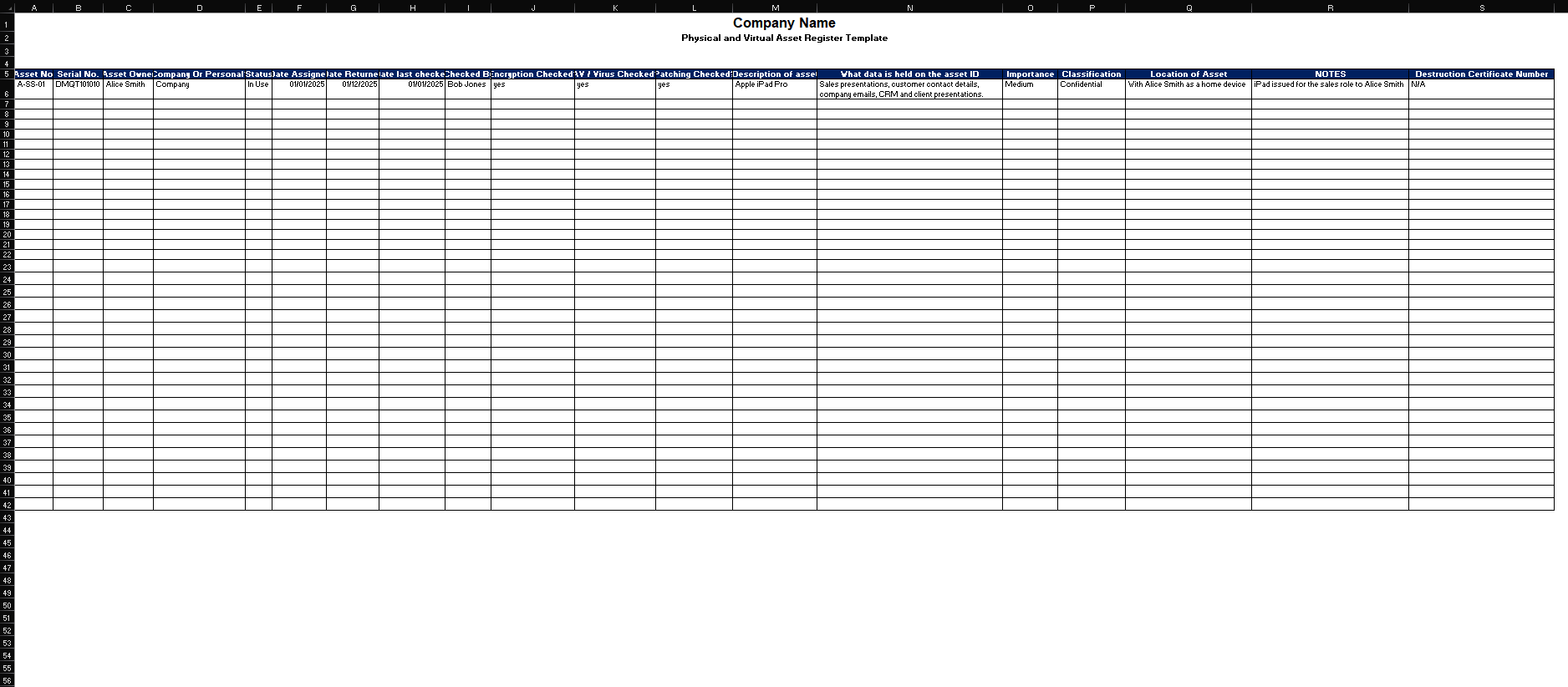
Physical and Virtual Asset Register Template
$4.99
✔️ ISO 27001:2022 Compliant
✔️ Prewritten and Ready to Go
✔️ Auditors Approved
✔️ Format: Microsoft Excel
This Physical and Virtual Asset Register simplifies how you inventory your critical assets, providing a structured template to identify, classify, and manage everything you need to protect.
Did you like this product? Add to favorites now and follow the product.
Description
The Ultimate ISO 27001 Physical and Virtual Asset Register
You Can’t Protect What You Don’t Know You Have
In today’s complex IT environments, with a mix of physical servers, cloud services, laptops, and countless software applications, keeping track of every single asset is a monumental challenge. Without a complete and current inventory, you have major security blind spots, “shadow IT” runs rampant, and your risk assessment is fundamentally flawed from the start.
Our ISO 27001 Physical and Virtual Asset Register is the solution to that challenge. It provides a comprehensive, pre-formatted template to create a centralized inventory of all your information assets. From laptops and servers to software licenses, critical databases, and cloud subscriptions, this register ensures you have a single source of truth for everything that your Information Security Management System (ISMS) needs to protect.
From the Experts at ISO 27001 Pro
From the experts at ISO 27001 Pro, this asset register is designed to be the starting point for your entire risk management program. We know that a thorough and well-maintained inventory is non-negotiable for a successful ISO 27001 audit. We’ve structured this template to capture all the essential details for each asset, including its owner, location, and classification, to build a strong foundation for your ISMS.
In-Depth ISO 27001 Compliance Breakdown
This asset register is the primary evidence for ISO 27001:2022 Annex A Control 5.9 (Inventory of information and other associated assets). It provides the detailed, documented inventory that auditors will expect to see as a foundational component of your ISMS. It helps you comply by:
- Identifying assets: The template provides a structured format to list all assets relevant to your ISMS, ensuring none are forgotten.
- Documenting owners: It includes a dedicated column to assign an ‘owner’ to every asset. This ensures clear responsibility and accountability for the protection of each asset, as required by the standard.
- Maintaining the inventory: It provides an easy-to-use format that can be regularly updated as assets are added, modified, or retired, ensuring your inventory remains accurate over time.
- Supporting Risk Assessment: A complete asset register is a critical prerequisite for your Clause 6.1.2 Risk Assessment. You must first identify your assets before you can effectively identify the threats and vulnerabilities that apply to them.
FAQ: Common Questions about the Asset Register
- What is considered an ‘information asset’ in ISO 27001? An information asset is anything that has value to the organization and is involved in the storing, processing, or transmitting of information. This is much broader than just hardware. Our template is structured to help you categorize physical assets (servers, laptops, phones), software assets (applications, operating systems), information/data assets (databases, critical files, intellectual property), and even service assets (cloud platforms like AWS or Microsoft 365).
- What kind of information should we record for each asset? For each asset, you should record key details to help you manage and protect it. Our template includes pre-built columns for essential information such as a unique asset ID, asset description, asset type (hardware, software, data, etc.), physical or virtual location, a named asset owner, and its information classification level (e.g., Confidential, Internal, Public).
- How is the asset register used in a risk assessment? The asset register is the essential starting point. For each asset you list (e.g., ‘Customer Database Server’), you then identify the potential threats (e.g., ‘hacker gains access’), vulnerabilities (e.g., ‘unpatched operating system’), and assess the resulting risk. Without the initial list of assets, you have no context for your risk assessment.
- This seems like a lot of work to maintain. How do we keep it up to date? Maintaining the register is a key process for your ISMS. Responsibility for updates should be formally assigned. Typically, this involves integrating the asset register with your procurement, change management, and decommissioning processes. When a new laptop is purchased, it’s added to the register. When an old server is retired, its status is updated in the register. Using a centralized template like this makes the process much more manageable than using scattered, informal lists.
Related products


Copyright 2026 © ISO 27001 PRO LLC. All right reserved.


Reviews
There are no reviews yet.